Categories
Bucknell/Local Interest Environment General GIS GIS in Geology Marcellus Shale Slideshow

NYT map graphic on toxic contamination from natural gas wells

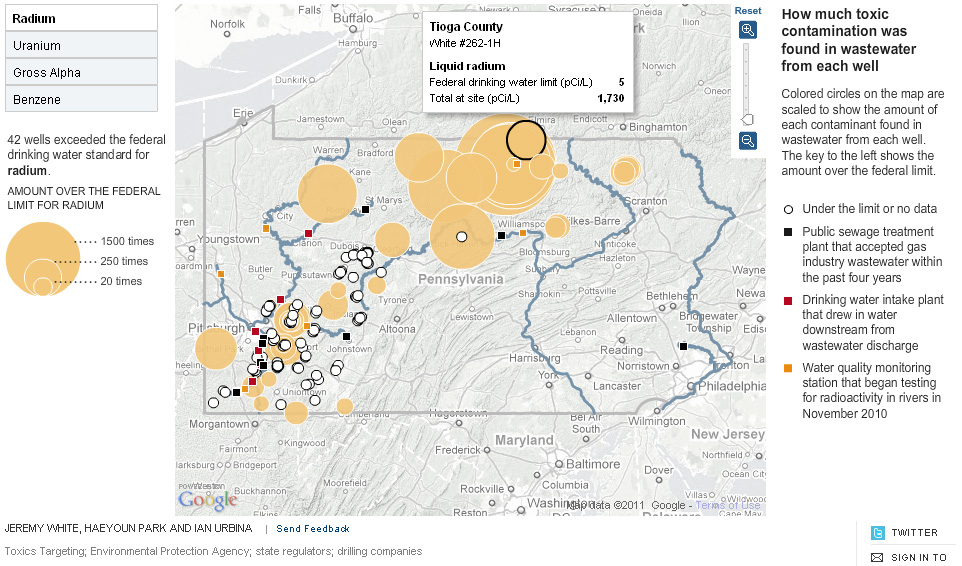
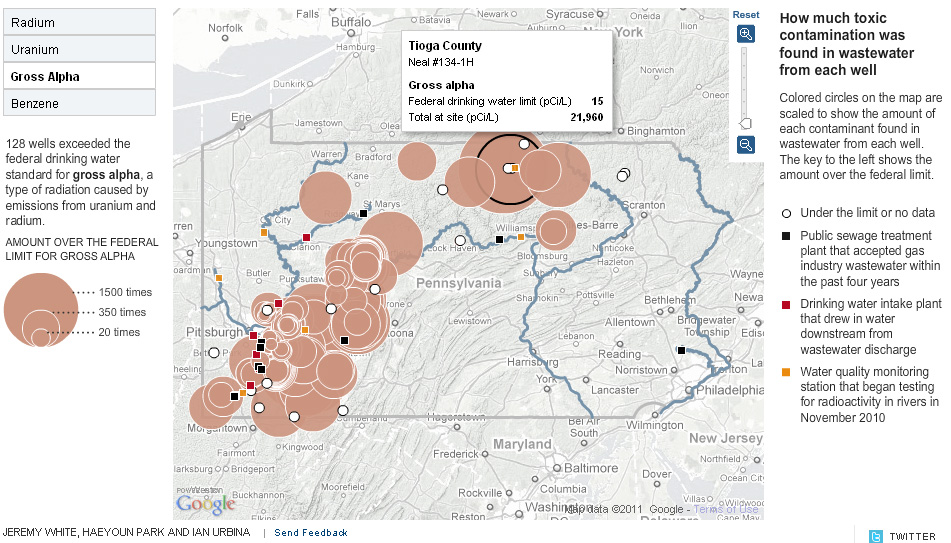
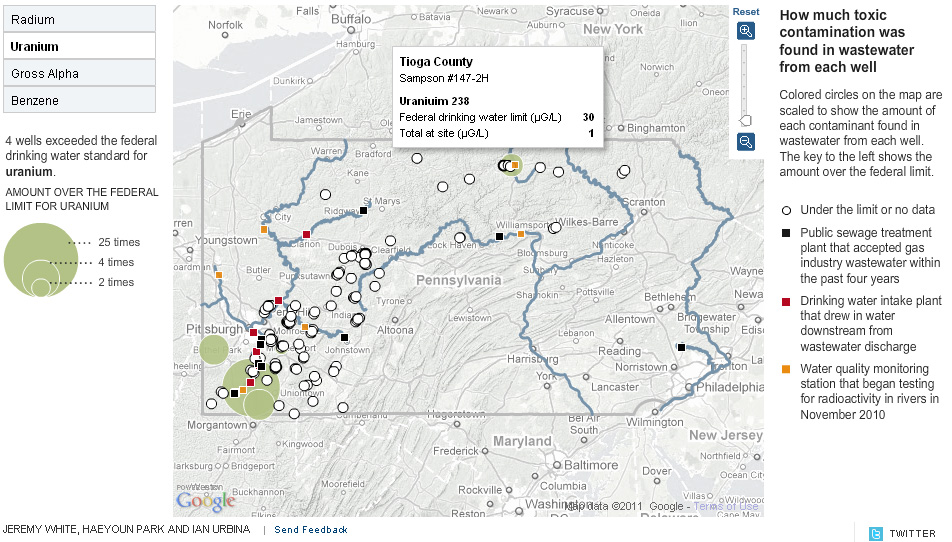
The New York Times has put out a new interactive map graphic that visualizes toxic contamination found in the wastewater from natural gas wells in PA.  The data – from 149 wells – is visualized by the type of contaminant (radium, uranium, gross alpha and benzene) and the amount by which each well exceeded the federal drinking water standard.  Below are some screenshots from the interactive graphic.

Radium contamination:


Uranium contamination:


Gross alpha contamination:


Benzene contamination:


Categories
Bucknell/Local Interest Data Environment General GIS Marcellus Shale

New conservation and Marcellus Shale-related data available on Xanthus GIS Server

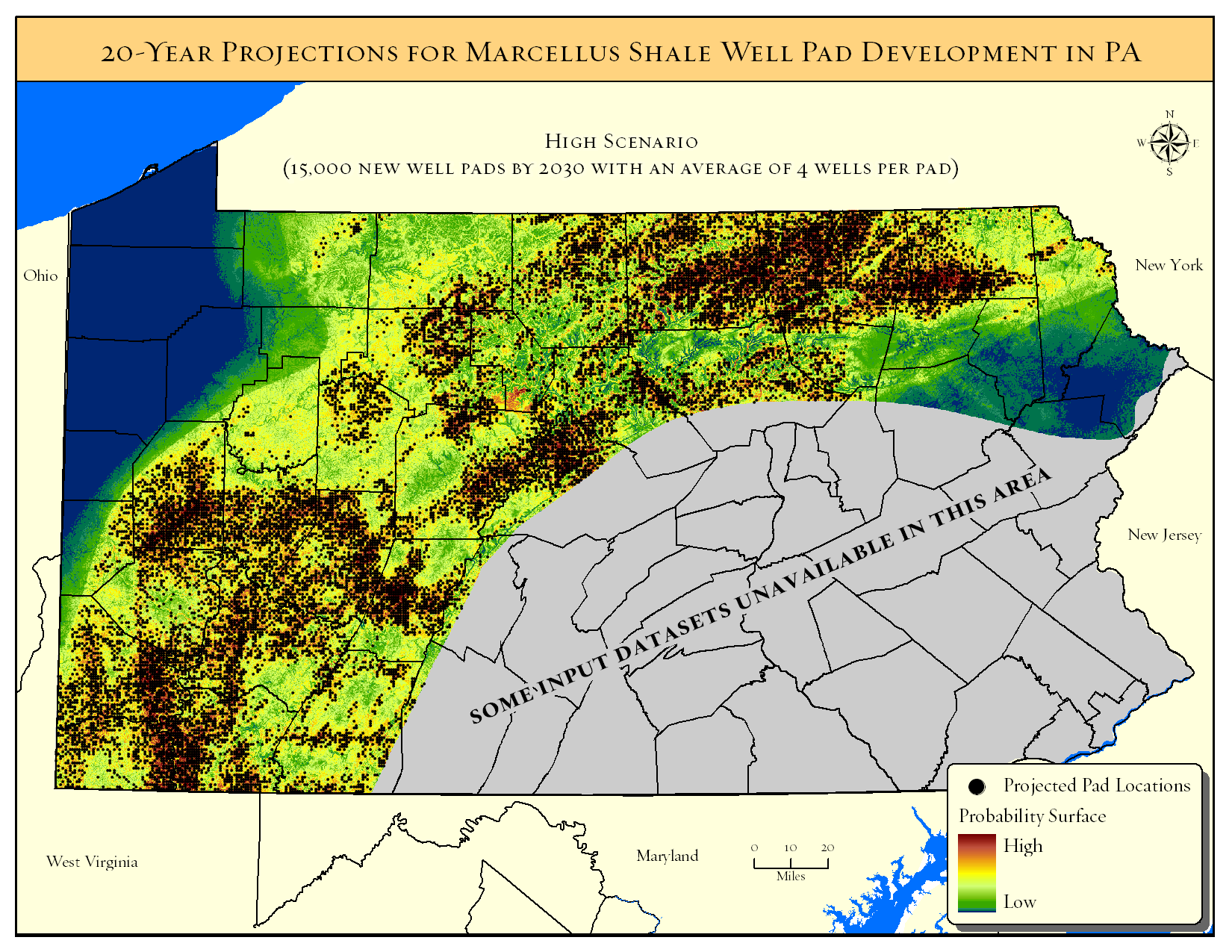
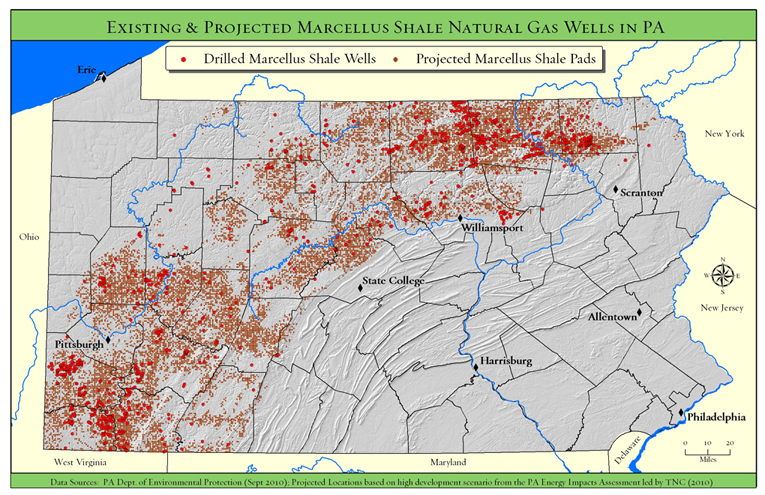
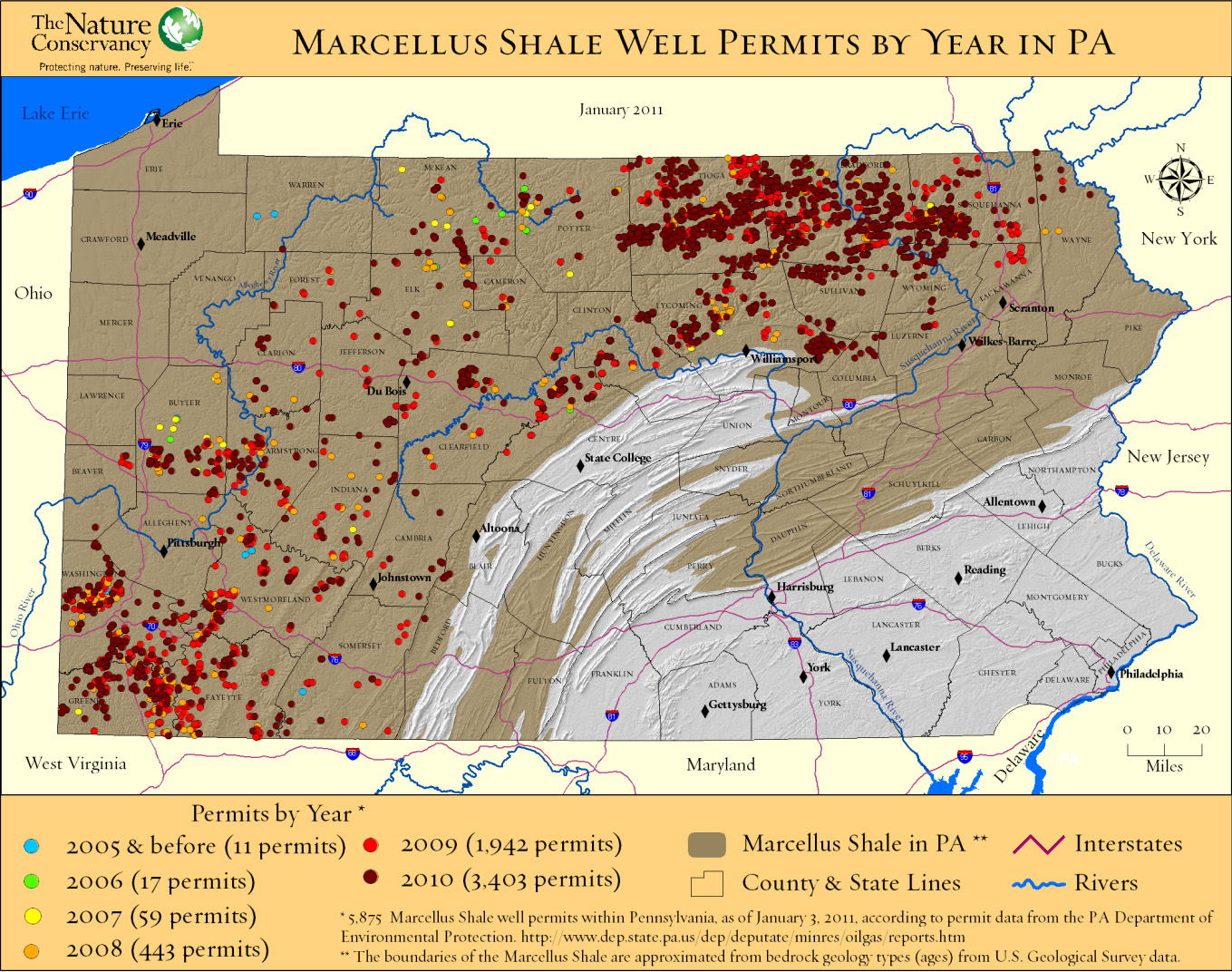
Several new datasets from Platts (an energy consulting firm) and the Nature Conservancy were added to the GIS Data folder on Xanthus last night.  The data includes gas compressor stations for PA, NY and WV along with current and projected locations of Marcellus Shale wells and wind turbines in PA.  Forest patches and landscape blocks are also included in the data from the Nature Conservancy . Full metadata is available on Xanthus. Bucknell faculty and students – please contact me for access and/or additional information on the new datasets.

Data from Platts:

Gas compressor station locations for PA, NY and WV.
Datasets from TNC’s Pennsylvania Energy Impacts Assessment:

Projections by The Nature Conservancy and Western Pennsylvania Conservancy

  • Probability surface of conversion to Marcellus Shale development
  • Projected Marcellus Shale pad locations under low, medium, and high development scenarios

Marcellus Shale drilling permits from the PA Department of Environmental Protection (PA DEP)

  • Drilled, valid, and expired Marcellus well permits as of January 2011
  • Drilled Marcellus Shale wells only as of January 2011

Projections by The Nature Conservancy and Western Pennsylvania Conservancy

  • Probability surface of conversion to wind energy development

—> Original model output at 30-meter resolution
—> Re-sampled raster at 60-meter resolution with exclusionary areas removed

  • Projected wind turbine locations under low, medium, and high development scenarios

Case information from the Federal Aviation Administration (FAA)

  • Built and proposed wind turbines and meteorological towers
  • Built large-scale wind turbines only
Categories
Bucknell/Local Interest Environment Events/Calendar General GIS Marcellus Shale Slideshow

Presentation by the Nature Conservancy – Monday, April 4th at 4:30pm

Save the date – April 4th at 4:30pm.  Tamara Gagnolet, GIS Analyst and Conservation Data Manager for the Pennsylvania chapter of the Nature Conservancy, will be at Bucknell on April 4th, 2011 to discuss her work in using GIS to analyze potential impacts of Marcellus Shale gas drilling in Pennsylvania. The Nature Conservancy recently released part 1 of its ‘Pennsylvania Energy Impacts Report’ – focusing on environmental impacts of Marcellus Shale gas-drilling and wind energy. Ms. Gagnolet’s presentation will focus on how GIS and spatial analysis were used to project how much energy might be developed in PA during the next 20 years, where that development is more or less likely to occur and what types of strategies might need to be employed to mitigate potential habitat impacts.

Presentation details: April 4th, 2011 at 4:30pm in the Bertrand Library Traditional Reading Room. Refreshments will be served.

Click here to read an earlier post about the Nature Conservancy report.

Categories
Bucknell/Local Interest Environment Events/Calendar General GIS Marcellus Shale

Upcoming presentation by The Nature Conservancy

Back in December I posted links to a new report and webinar by the Nature Conservancy describing their use of GIS to analyze potential Marcellus Shale impacts in PA.  At some point in April we’ll have the Nature Conservancy team here at Bucknell for a presentation of their work.  Stay tuned for more details…

Categories
Bucknell/Local Interest Environment General GIS Marcellus Shale Slideshow

Using GIS to analyze Marcellus Shale impacts in Pennsylvania

The Nature Conservancy recently released a study analyzing potential habitat impacts of energy development – including Marcellus Shale – in Pennsylvania over the next 20 years. Click here to watch a recorded presentation by the two lead researchers on the project. Click here for a copy of the full report.

The presentation includes discussion of how GIS and spatial analysis were used to project how much energy might be developed in PA during the next 20 years and where that development is more or less likely to occur.